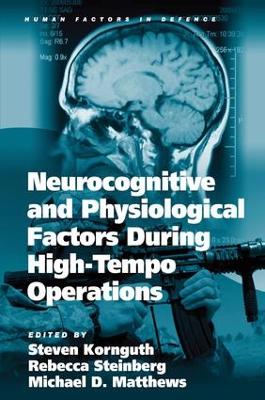
Neurocognitive and Physiological Factors During High-Tempo Operations
 -15%
portes grátis
-15%
portes grátis
Neurocognitive and Physiological Factors During High-Tempo Operations
Kornguth, Steven; Steinberg, Rebecca; Matthews, Michael D.
Taylor & Francis Ltd
05/2010
286
Dura
Inglês
9780754679233
15 a 20 dias
690
Descrição não disponível.
Contents: Foreword; Introduction, Steve Kornguth; Part 1 Cognition During Real-World Activities: Promises and challenges in translating neurofunctional research for army applications, Richard J. Genik II; Modeling the impact of workload in network centric supervisory control settings, Mary L. Cummings and C.E. Nehme; Systematic measurements of human behavior in naturalistic settings, Matthew Rizzo and Joan Severson; Noninvasive monitoring of brain function with near infrared light, Andrew K. Dunn. Part 2 Cognition During Sleep Deprivation: Individual differences to sleep deprivation vulnerability and the neural connection with task strategy, metacognition, visual spatial attention, and white matter differences, Matthew Rocklage, W. Todd Maddox, Logan T. Trujillo and David M. Schnyer; Identification and prediction of substantial differential vulnerability to the neurobehavioral effects of sleep loss, David F. Dinges and Namni Goel; Sustaining performance: the other side of sleep, Robert Stickgold; Factors affecting mnemonic performance in a nonhuman primate model of cognitive work load, Robert E. Hampson and Sam A. Deadwyler. Part 3 Cognition during Stress and Anxiety: Systems neuroscience approaches to measure brain mechanisms underlying resilience - towards optimizing performance, Martin P. Paulus, Alan N. Simmons, Eric G. Potterat, Karl F. van Orden and Judith L. Swain; The cognitive neuroscience of insight and its antecedents, John Kounios and Mark Beeman; Decision-making under risk and stress: developing a testable model, Richard Gonzalez and Israel Liberzon; Brain processes during expert cognitive-motor performance: the impact of mental stress and emotion regulation, Bradley D. Hatfield and Amy J. Haufler. Part 4 Guidance from Military Leadership and Ethical Considerations: Military operations: humans not machines make the difference, James L. Merlo; Is supraphysiological enhancement possible, and what are the downsides?, Karl E. Friedl; The US army future concept for the human dimension: chief human dimension executive summary, Steven Chandler; Sustaining performance in mass casualty environments, Annette Sobell; Neuropsychiatry and aviation safety, Robert R. Ireland; Closing remarks: realization of existing capabilities in sustaining performance, Rebecca M. Steinberg, Michael D. Matthews and Steve Kornguth; Index.
Este título pertence ao(s) assunto(s) indicados(s). Para ver outros títulos clique no assunto desejado.
cognitive resilience;sleep deprivation effects;human performance assessment;decision-making under stress;military neuroscience applications;fatigue monitoring technology;sustained attention in operational environments
Contents: Foreword; Introduction, Steve Kornguth; Part 1 Cognition During Real-World Activities: Promises and challenges in translating neurofunctional research for army applications, Richard J. Genik II; Modeling the impact of workload in network centric supervisory control settings, Mary L. Cummings and C.E. Nehme; Systematic measurements of human behavior in naturalistic settings, Matthew Rizzo and Joan Severson; Noninvasive monitoring of brain function with near infrared light, Andrew K. Dunn. Part 2 Cognition During Sleep Deprivation: Individual differences to sleep deprivation vulnerability and the neural connection with task strategy, metacognition, visual spatial attention, and white matter differences, Matthew Rocklage, W. Todd Maddox, Logan T. Trujillo and David M. Schnyer; Identification and prediction of substantial differential vulnerability to the neurobehavioral effects of sleep loss, David F. Dinges and Namni Goel; Sustaining performance: the other side of sleep, Robert Stickgold; Factors affecting mnemonic performance in a nonhuman primate model of cognitive work load, Robert E. Hampson and Sam A. Deadwyler. Part 3 Cognition during Stress and Anxiety: Systems neuroscience approaches to measure brain mechanisms underlying resilience - towards optimizing performance, Martin P. Paulus, Alan N. Simmons, Eric G. Potterat, Karl F. van Orden and Judith L. Swain; The cognitive neuroscience of insight and its antecedents, John Kounios and Mark Beeman; Decision-making under risk and stress: developing a testable model, Richard Gonzalez and Israel Liberzon; Brain processes during expert cognitive-motor performance: the impact of mental stress and emotion regulation, Bradley D. Hatfield and Amy J. Haufler. Part 4 Guidance from Military Leadership and Ethical Considerations: Military operations: humans not machines make the difference, James L. Merlo; Is supraphysiological enhancement possible, and what are the downsides?, Karl E. Friedl; The US army future concept for the human dimension: chief human dimension executive summary, Steven Chandler; Sustaining performance in mass casualty environments, Annette Sobell; Neuropsychiatry and aviation safety, Robert R. Ireland; Closing remarks: realization of existing capabilities in sustaining performance, Rebecca M. Steinberg, Michael D. Matthews and Steve Kornguth; Index.
Este título pertence ao(s) assunto(s) indicados(s). Para ver outros títulos clique no assunto desejado.